


Is Real Food Right For You?

Is Real Food Right For You?
This is a special guest blog post by Lara Field, MS, RD, CSP
If you’ve only ever used formula in your feeding tube, the idea of transitioning to real food can seem overwhelming. When deciding whether to add real food to your tube-fed diet, whether you’re blending from home or using Real Food Blends, there are really only a few things to consider. For many people, real food is a very real possibility. Make sure to consult your medical team before making any change to your tube feeding regimen, but if you’re looking to start incorporating real food, consider the following:
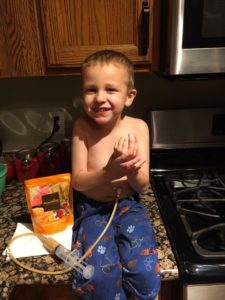 Age
Real food, including Real Food Blends meals, is not limited to only children or only adults. Just like for oral eaters, infants under the age of 1 should stick to breastmilk and formula, but once a child hits their first birthday, parents can begin transitioning to real food. (Check out our past guest blog post from Weronika Brill RN with tips for transitioning a 1-year-old tubie to a blended diet.) Breastmilk/formula provide essential nutrition for babies under 1 year of age, and solid foods are supposed to be complementary, so we suggest waiting until your child depends on food for 100% of their nutrition. Adults of any age, especially those who previously ate regular food, can consider real food through their feeding tubes.
Why a Feeding Tube?
The original reason for the feeding tube being placed is the most important thing to consider when looking into real food. If the tube was placed because of an inability to consume enough calories orally, or to safely get food into the stomach (i.e. risk of aspiration), then the digestive system should still be working. If the stomach and digestive tract work as they should, real food can – and many would say should – be considered.
However, if the tube was placed due to malabsorption or digestive issues, you may be unable to properly digest or absorb real food and require a specialized formula. There’s no firm evidence or anyone tracking this to our knowledge, but most people we meet that have feeding tubes usually have them because of the risk of aspiration or an inability to get enough calories orally – not because their stomach wasn’t working! These “tubies” are excellent candidates to continue to benefit from whole food nutrition.
It’s important to look at the original reason for the tube being placed. I have seen many patients throughout my career that end up on broken-down or specialized formulas after tube-feedings were introduced – this is more likely a sign of formula intolerance, not a sudden digestive issue if the patient has been eating regular food their whole life.
G-Tube vs J-Tube

Although real food can be used with a J-tube, many tubies and medical professionals can be hesitant to move away from formula in these cases. As discussed above, what should be considered first is why the J-tube was placed and why G-tube feeds failed. It’s entirely possible that the failure of G-tube feedings in some patients is due to formula intolerance, not a digestive issue that necessitates J-tube feedings. With medical approval, blended foods and Real Food Blends meals can be used with a J-tube, but extra caution should be taken to make sure the blends are thin enough and strained of any extra food particles. (For G-tubes, Real Food Blends meals are tested to work with 14f or larger tubes.)
Why Real Food?
Aside from common sense (hello, fruits and veggies!), there is a growing body of research showing that real food through feeding tubes can improve many typical symptoms of formula intolerance, including acid reflux, vomiting, nausea, constipation, diarrhea, weight loss/lack of weight gain, and/or requiring overnight or continuous feeding. Conversely, there are no documented, clinical studies showing that enteral formula is preferable over a whole food for long term use – wouldn’t we all be drinking enteral formula if that was the case!? Using real food also allows those with feeding tubes to benefit from having a varied diet with a wide variety of nutrients (just like I recommend to oral eaters!) in a way that is impossible with commercial formula (learn more about the importance of nutritional variety).
If you or your loved one with a feeding tube meet the simple requirements described above, then real food is something you should be discussing with your doctors.

Lara Field, MS, RD, CSP, is an accomplished Registered Dietitian and the founder of FEED (Forming Early Eating Decisions), a nutritional consultancy based in Chicago. Mrs. Field is an advisor to Real Food Blends and has extensive clinic and internship experience at top ranked institutions including Lurie Children’s Hospital, University of Chicago Comer Children’s Hospital, Rush University Medical Center, and Johns Hopkins.
Transitioning Away From Overnight Feeds

Transitioning Away From Overnight Feeds
Almost daily here at Real Food Blends, we get asked if our meals can be used for overnight feeds or if they can put the meals on ice to feed overnight or if the meals can go through a pump to be fed overnight….
Wait, what? Eating while sleeping??
 When you start to think in terms of MEALS and less in terms of FEEDS, feeding overnight starts to sound a little strange. Oral eaters don’t have to wake up every night to eat, right? And many would argue that our digestive systems need to rest at night.
For some people, the idea of NOT feeding overnight is super scary – “How will we ever hit our calorie goal? We can’t get that volume amount in during the day!” These questions are almost always from those who are 100% formula fed. (Requiring overnight feeds can be a sign of formula intolerance however some conditions require so many extra calories that overnight feeds are a must – cystic fibrosis is one that comes to mind immediately – but we’re speaking in generalities here!)
To our knowledge no one has really studied this, but in our experiences and from a lot of anecdotal “evidence,” overnight feedings can lead to volume intolerance during the day (especially in the morning – who’d want to eat breakfast after eating all night?), increased risk of reflux/aspiration (usually due to not being upright for eating, you try to eat laying down and see how you feel!), disrupted sleep, and scary episodes of vomiting/choking.
If the only reason you or the person in your life with a feeding tube requires overnight feeds is to hit a calorie goal, read on:
Real Food
The first tip we’d offer is to introduce real food into the tube-feeding diet. Real Food Blends meals are thicker than formula in part to provide more nutrition and calories per ounce, making it easier to meet your calorie needs in a shorter amount of time. (There’s also some evidence that volume tolerances increase with real food.) Real food can be used alone or with formula and transitioning someone who has been exclusively on formula for any amount of time should be done slowly (read more about how to transition from formula to a real food diet. See also: Is Real Food Right For Me?)
Normal Mealtime Schedule
We like having a goal to move to a normal mealtime schedule – breakfast, lunch, snack, dinner – when transitioning to real food. Again, if you think about this from an evolutionary perspective, this is how humans have been eating for ages! This transition should be done slowly and over time—you may want to gradually increase the amount of food given during the day and slowly decrease the amount of formula given overnight. The more calories you can get in during the day, the fewer you’ll have to give during an overnight feed, with the goal of getting all your necessary calories in during waking hours (like humans have been doing for ages!)
Think Midnight Snack
While making this transition, giving a small bolus feeding at night instead of a continuous overnight feed might be helpful. Think of it more as a “midnight snack”—the stomach still gets to rest during most of the night and you have another opportunity to get some extra calories in while you’re transitioning away from overnight feeds.
Volume
If volume is a concern, we suggest going slow and adding additional volume in small increments during the day, perhaps starting out with just an additional half an ounce per meal. Many people have found that giving free water prior to a meal can help increase volume tolerance as well—make sure to discuss hydration needs with your medical team. See also: Tube Feeding and Volume Intolerance
“I have had my feeding tube for almost 4 years now. I had tried multiple different formulas that were just marking me very sick so I would just go without food. I tried just making home blends but was struggling to balance the vitamins and calories so I was still getting sick. I tried Real Food Blends and the difference was night and day no more reflux no more heart burn.”
- RFB customer Kim Inslee-Pomerleau
What’s your experience with overnight feeds been? Have you been able to successfully transition off the tube at night? We’d love to here your feedback here or on Facebook.
*****
As always, please talk to your doctors before making any changes to your tube-feeding diet. This is not to be considered medical advice.

Poster presentation from NASPGHAN 2019 showing, “A continuous overnight tube feeding scheduled does not appear to promote increased oral intake in comparison to a daytime bolus feeding schedule.”
Tube Feeding and Volume Intolerance
Tube Feeding and Volume Intolerance
Volume intolerance refers to the inability for a person with a feeding tube to handle a typical tube feed in a normal period of time. The volume and time frame can vary by age, caloric needs, etc. There’s not really a threshold for this. If you compare how long it takes for a person who eats orally to finish a meal versus how long it takes for someone on a feeding tube to finish their meal, this can give you context of volume tolerance/intolerance. If you are tube-fed and need to have your full formula feed dripped in slowly over a long period of time (anything over an hour), you could be considered volume intolerant.
Before I had a child with a feeding tube, I had never heard this term. Us oral eaters don’t talk about being “volume intolerant” – we just stop eating before we get too full! But in the tube-feeding world, this term is often cited as a side effect of tube feeding. The typical ways to deal with it? Slow down the feeds, feed smaller meals more often or maybe even switch formulas. “Volume intolerance” is how many people with a feeding tube end up on a slow drip of formula over the course of a day or on continuous or overnight feeds in order to get the prescribed calories in each day.
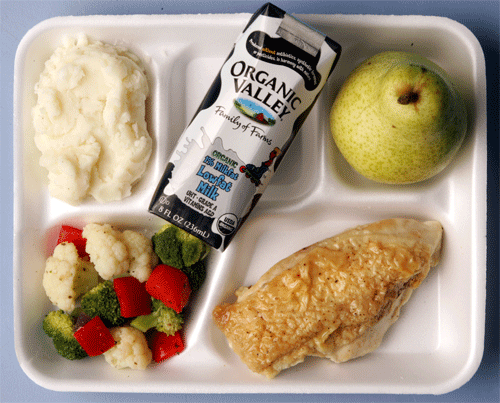
One of the anecdotal things we often hear in the tube-feeding community is that ‘volume tolerance’ improves with real food. Magic elixir? Hardly … think of it this way. If you were a typical eating child, the photo to the left is an example of what the USDA recommends you have for lunch (see more details at choosemyplate.gov). So why do so many people with feeding tubes – even adults – have a hard time handling 8 ounces of formula in a 20-30 minute period? That’s volume (or formula) intolerance.
How to improve volume tolerance for tube-feeding
“Overall, we have found greater volume tolerance and improvements in reflux and constipation when switching from commercial formulas to blenderized tube feedings.” – The Use of Blenderized Tubefeeding, Novak / Wilson
“It is a well-known fact that most tubes tolerate far higher volumes of food than formula, and much of this is down to the feel of the food; how our bodies communicate with us about the appropriateness of our nutritional needs.” – Complete Tubefeeding, O’Gorman
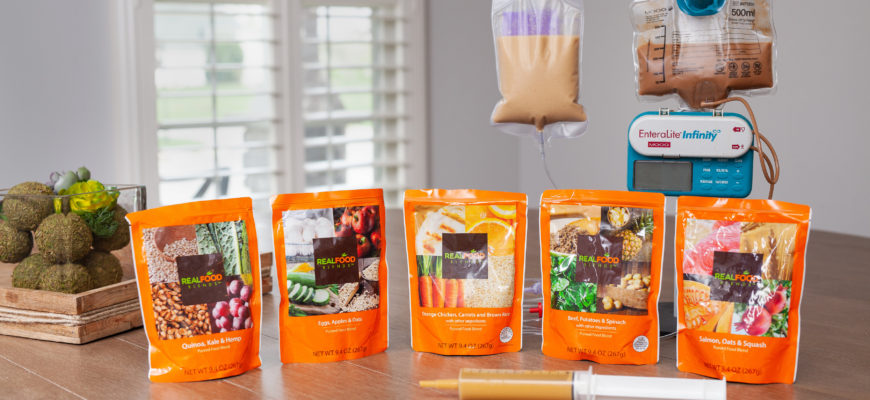
Switching from an enteral formula-only diet to real food through the feeding tube can help some people with volume intolerance issues. Real Food Blends meals are intentionally thicker than traditional formulas partly to provide more nutrition / calories per ounce. Each pouch yields an 8 ounce serving at about 40 calories per ounce. An 8 ounce serving of our 100% real food meals will provide approximately 80 more calories per serving than a traditional enteral formula so those people with volume issues can take in more calories in the same amount of food. We have tips for transitioning to our meals from a formula-only diet here, and usually recommend that you keep the same volume over the same amount of time that you would feed formula to start.
Once you have established that our meals are working well for you, you can begin to experiment with volume changes. Moving to a more normal mealtime schedule (breakfast, lunch, snack and dinner) is possible and preferable for many people with a feeding tube!
Time or Volume?
It’s important to think of volume tolerance in terms of goals. Are you trying to shorten the amount of feeding time per meal/day, or is it more important to you to increase the amount of food at each meal? We suggest only trying to do one or the other to start. Most people, especially kids, can’t just go to this right away:
If you are having 8 ounces over a 45-minute period, your first goal may be to shorten the feeding time to 40 minutes. If tolerated well, then move down to 35 minutes. This is all trial and error but slowly shifting to a normal meal timeframe can free up a lot more time in your day (within reason! Some people have their meals in a few minutes, some will need 20-30 minutes. Both of these are pretty normal – we all know that some people are fast, or slow, oral eaters!) If you are caring for someone who is nonverbal or unable to communicate, you’ll need to look for other clues as to how this is being tolerated:
“Children with a feeding tube often discover other physical ways of saying ‘no.’ Gagging and retching may be the response of a child who is beginning to feel uncomfortable. The child may become physically tense and emotionally stressed from the fear of getting too much food or feeling sick. Children who increase tension on the abdomen, cry or develop irregular breathing patterns often find their tension will slow down or stop the flow of the formula. Their increased agitation during the meal can limit the amount of formula they receive, but it also increased gastrointestinal discomfort.” – Suzanne Evans Morris, Ph.D, CCC, “Mealtime Communication and Homemade Blended Formulas” from Homemade Blended Formula Handbook
If your first goal is to increase the amount of food / calories being served at each meal, again, we suggest going slow. Using our same example above of an 8 ounce serving over 45 minutes, you may want to start at adding a half ounce to each meal to see how that’s being tolerated. Over 3-4 meals a day, that’s another 120 or so calories, which can add up!
Again, if the person with a feeding tube is unable to communicate, you’ll need to look for other indications that they are full / that the increased volume is – or isn’t – being handled well. Additionally, you may find that the digestive system speeds up with the introduction of real food and will need to look for hunger clues BEFORE the next scheduled meal. Some people find that checking residuals can help determine if the person is ready for the next meal / more food / volume.

” We usually struggle to get 8 ozs in of formula because she is too full but she was able to take the whole packet without a peep!” Peyton’s mom, Tracy, shared on our Facebook page
Free Water
One of the tips that often seems counter-intuitive to increasing volume tolerance is increasing the free water given. Free water refers to water given through the tube outside of what’s in a formula or blend. (Again, us oral eaters would call this a drink of water!)
“Many parents and therapists have found that offering a water bolus 30 minutes prior to the tube meal supports both the greater fluid needs of a child receiving thicker food-based formulas and improves the child’s volume tolerance.” –Jude Trautlein, RD, Homemade Blended Formulas and Hydration, also from Homemade Blended Formula Handbook.
It’s very important to discuss hydration needs with your medical team. Your doctor or dietitian should be able to give an acceptable range of water needed per day based on your height, weight, age and medical conditions. Also, always monitor outputs (is the person urinating normally? How are bowel movements?).
Lastly, it’s important to remember that every body and every condition is different. Fed is best and a normal mealtime schedule might not be possible for everyone. Also, remember that illness can impact volume tolerance and even after an illness has passed, volume tolerance may not immediately go back to normal.
What’s worked for you / your loved one when it comes to volume tolerance? We’d love to hear from you on our Facebook page.
As always, do not make any changes to your enteral diet without consulting with your medical team. This should not be taken as medical advice. For more information on feeding intolerance, go to Feeding Tube Awareness.
Blenderized Diet Research
(Note: As of this post, more and more studies have been published showing that a wide variety of real whole food is good for people! Even people with feeding tubes! We are compiling all the studies on blenderized diets here.)
Back when I first starting feeding my son a blenderized diet 4+ years ago and then founded Real Food Blends, there wasn’t much actual research as to the benefits of putting real food through the feeding tube.
Luckily, there was A LOT of anecdotal evidence, a few books on the subject (two notable: Homemade Blended Diet Handbook and Complete Tubefeeding) and Facebook really empowered those with feeding tubes to connect with one another and share their experiences with real food.
How times have changed! We have compiled a list of blenderized diet research and observational studies from medical professionals below. Our hope is that this information can assist you in receiving physician support, insurance coverage for our meals, and make it easier for medical professionals to proactively suggest real food for people with tubes by having proven, documented reasons that people with feeding tubes can benefit from blenderized diets.
—-
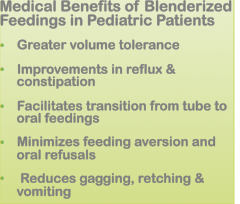
The Use of Blenderized Tube Feedings (2009) Although this isn’t a study per se, this printed roundtable
From ICAN: Infant, Child, & Adolescent Nutrition February 2009 vol. 1 no. 1 21-23
discussion of blenderized diets from medical professionals can be useful and give some ‘teeth’ to the blenderized diet anecdotes.
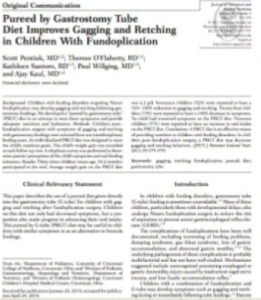
Pureed by gastrostomy tube diet improves gagging and retching in children with fundoplication (University of Cincinnati College of Medicine, 2011)
- Thirty-three children (mean age, 34.2 months) participated in the trial. Average weight gain on the PBGT diet was 6.2 g/d. Seventeen children (52%) were reported to have a 76%-100% reduction in gagging and retching. Twenty-four children (73%) were reported to have a ≥ 50% decrease in symptoms. No child had worsened symptoms on the PBGT diet. Nineteen children (57%) were reported to have an increase in oral intake on the PBGT diet.
- Conclusions: A PBGT diet is an effective means of providing nutrition to children with feeding disorders. In children post-fundoplication surgery, a PBGT diet may decrease gagging and retching behaviors.
In the past year, we’ve seen an increase in the number of published surveys and studies done, and they generally show the same results:
Blenderized Tube Feeding Use in Adult Home Enteral Nutrition Patients: A Cross-Sectional Study (Mayo Clinic, 2015)
“Most common reasons for using BTF were as follows: it is more natural (43%), like eating what their family does (33%), and tolerate BTF better (30%). In patients who use BTF, 80% reported maintaining goal body weight. BTF resulted in significantly less reported nausea, vomiting, bloating, diarrhea, and constipation compared with commercial EN. Conclusions: This is the first study to evaluate BTF use in an adult HEN population. More than 50% of our patients used and approximately 80% expressed a desire to use BTF if provided with adequate information.”
Tolerance of Pureed Diet by Gastrosonomy Tube in Pediatric Patients, Children’s Hospital of Michigan / Wayne State Medical School (Presented at NASPGHAN, 2014)
Conclusion: The pureed diet by GT is an alternative diet that is well received by families of patients. The pureed diet can improve the gagging / retching, oral tolerance, weight velocities, and stooling habits. Adverse effects of the pureed diet are limited.
The BLEND Study: A Feasibility study looking at children transitioning onto blenderized tube feeds, The Sick Kids (Presented at NASPGHAN, 2015)
Conclusion: Fewer subjects reported emesis and stools became firmer. Use of antacids, motility agents, and laxatives did NOT increase. 1.5 times more calories were required to maintain anthropometrics. Caregivers perception of BLEND was positive.
Short-Term Outcomes Using Blenderized Tube Feedings Among Gastrostomy-Tube Dependent Children, Children’s Hospital of Orange County (Presented at NASPGHAN, 2015)
Conclusion: Pediatric patients who are dependent on gtube feedings may benefit from BTF for improvement in stool consistency, vomiting, and gtube intolerance. Full BTF may result in better outcomes than combination foods. Frequent monitoring of anthropometric measurements is warranted to promote age appropriate growth.
—-
We’re happy to see the increased interest in studying blended diets (although I do like to tease that we’re studying putting real food into real stomachs – it’s been done for THOUSANDS of years!)
If you or someone you are caring for has a feeding tube and has any of the above-mentioned symptoms (vomiting, reflux, failure to gain weight, weight loss, diarrhea / constipation, oral aversion, feeding refusal, or general formula intolerance), these studies should help get your medical team on board with a blended diet. Our Real Food Blends meals can be a very simple way to implement a blenderized diet.
Questions? Comments? We’d love to hear from you below or on our Facebook page.
Hospital Options on Blended Diets
The following is a guest blog post from Weronika Brill RN.
Hospital visits can become a large part of a special needs child’s life. Between surgeries, procedures and pneumonias, spending time in the hospital can be stressful on the whole family. But having a child that “eats” a blenderized diet (BD) through a tube can leave a family unsure as to what their options are.
As a registered nurse that has worked in hospitals almost my entire career, I know that you have a lot of options and that you can be prepared for any hospital stay.
Hospital policy
If there is a regular hospital that you bring your child to make sure to call them to find out if they have a policy in place about blended food. Ask to speak with a patient advocate or a member of the dietary staff.

Tammy shared: “The picture turned out a bit blurry, but I do have to say that Real Food Blends were a lifesaver this past month when my son was in the hospital after having hip surgery.”
It will be good for you to know ahead of time because you can a) choose to go to a different hospital if they have a policy against it or b) if they do not have a policy against it you will have that knowledge in case a staff member tells you that you can’t give your child a home blend.
If policy does not allow home blends, make sure to ask if they will allow Real Food Blends. Even if they have a policy against blended food from home they should allow Real Food Blends because it is shelf stable and “controlled.” Many hospitals are even carrying Real Food Blends, so make sure you find out ahead of time to reduce stress. (Real Food Blends are available through Independence Medical, McKesson or Medline – most hospitals receive daily deliveries of supplies from one of these major distributors.)
Your last option, if they won’t allow blended diets, is asking for a fine puree meal to be sent up that you can mix with milk, water or broth and give through the tube without blending. You can have a meal sent up in almost any way as long as the doctor orders it.
Have the doctor on your side
If you are planning for a surgery, or even if you have an emergency, it is always good to have a calm conversation with the doctor who will be in charge of your child’s care. If there is a planned surgery it is good to speak with the surgeon at his/her clinic before the surgery and also at the time of the check in. If you’re in the emergency department, you can speak with the admitting physician. If the doctor agrees with you, and decides to order your home blend or Real Food Blends, then you are in a great place.
What orders to ask for?
The following are options for orders from the doctor regarding diets. The doctor may not word it exactly like this, but he will understand your request. Note: all puree diets from the hospital will be ordered as pediatric and should be balanced nutritionally.
- For clear fluids: “Clear fluids as per broth and juice from home. Clear fluids to be given through G-tube.” Or “Clear fluids tray (from hospital), clear fluids to be given per G-tube.” Or the doctor may order more specifically “Clear fluid tray 4 meals/day.” In some hospitals the dietary staff may ask for the specifics later.
- For Real Food Blends: If you will bring in your own, “Real Food Blends through G-tube as per home feeding schedule.” If the hospital carries Real Food Blends make sure the doctor or dietary staff knows how many meals or calories a day your child eats.
- For home blend: “Home blend diet through g-tube as per home feeding schedule. Parents will bring in blend.” Or “Home formula through G-tube as per home feeding schedule. Parents will bring in blend.”
- For using hospital puree food: “Fine puree pediatric diet tray (from hospital). Parents or nurses may mix with broth, milk or water and give through the G-tube as per home meal schedule.”
Handling staff members that disagree with your BD
We all know that most nurses and dietitians are supportive and great people, but every one of us has been in a situation where a staff member tells you that you can’t continue what you are doing because it’s against policy or some other reason.
First, you should already be aware of the hospital policy and remind them of it. Also, make them aware of the orders that you already have from the doctor.
If you have any further issues with that employee, do not argue or get upset, just ask to speak with the doctor or resident that is on call. Being a nurse I know we are there to not only ensure the safety of our patients but also to carry out the doctor’s orders and nursing care plan. We are not there to disagree with an order just because we don’t agree with it or feel it is wrong. Once you have a doctor in the room, calmly explain the situation and the orders the attending doctor ordered for you. If you kindly state that there is a miscommunication between the staff member and those orders, things should be cleared up rather quickly.
My biggest piece of advice about communication between you and the staff is that you will get a lot further if you keep a calm demeanor and not argue with anyone.
The diets
- Clear fluid (clear liquid) Many doctors will order clear fluids after surgery or a procedure. Things like bone broth, pedialyte and clear juice are all considered clear fluids. Your doctor may want your child to have pedialyte, but I always give my son home made bone broth instead (being on a ketogenic diet he can’t have the dextrose in the pedialyte). Homemade bone broth has electrolytes and minerals and can sustain a person for a while. My son was on clear homemade bone broth for three days in hospital and all of his electrolytes were normal during that time. If your hospital allows it, you can bring clear bone broth from home in a thermos. My recipe for bone broth is here (Real Food Blends broth recipe is here):
You can also have the hospital send up clear chicken or beef broth. I would recommend the low sodium option unless the doctor wants the regular sodium option.
- Full fluid (full liquid) A full fluid diet is a kind of step between the clear fluids and a regular diet. I’ve seen it ordered a lot for bowel surgeries, as the transition to a regular diet is slower. Things that fall into this diet are milk, milk shakes, custards, puddings, fruit juices, nectars, cream of wheat, cream of rice, ice creams and any clear fluids. You can ask your nurse or dietitian for a full list of approved full fluids for your child. With full fluids they may not need to be blended so it could be easier to have the hospital send up the fluids. You may have to add water or other fluids to make it less thick but you should be able to push all of it pretty easily.
- Regular diet A regular diet is just the diet that your child “eats” at home. It can be a low fat/high carb diet or even a ketogenic diet but it’s still your child’s regular diet. Once this diet is ordered you can use your Real Food Blend packages or any blends that you bring from home. Another option is asking for a regular meal sent up as a fine puree. You can just mix the puree with broth, milk or water and push it down the g-tube. Some hospitals will not allow this, as they may not be able to blend it as fine as needed for a BD.

Real Food Blends quinoa meal being fed to a patient at the Rehab Institute of Chicago
Have a plan
After spending most of 2014 in and out of hospitals my husband and I now have a plan in place. We have to have our own blends because of the ketogenic diet and it’s many restrictions.
- Thermoses: We have about five high quality thermoses that we use every time we have a hospital stay. They are great for keeping things cool but even better at keeping them hot.
- Frozen clear broth: I have a freezer full of frozen broth in 8oz portions. I freeze them in ziplock bags and then put them into a pot (without the ziplock bag), frozen, and slowly bring to a boil. This allows me to quickly grab the correct amount out of my freezer. Because my son doesn’t get as full from the clear bone broth he wants to eat more often so I’ll keep 5-6 portions in my thermos for a day.
- Frozen soup blend: Whenever my son is in the hospital he has an extra sensitive stomach and I don’t give him blends with avocado or anything thick. I give him a blend of homemade bone broth, chicken and some carrot and find that he tolerates soup very well and it soothes him.
- Real Food Blends: Keep Real Food Blends around for your hospital stays or longs days going to procedures and doctor visits. They are also great to have if the power goes out, or if you’re unable to get home in time to feed your child. Many of my clients use Real Food Blends for their child’s lunch at school and for vacations.
- Preparation: When my son is in the hospital, either my husband or I will warm up one day’s worth of soup blend and keep it in the thermos for the entire day. Whoever stays at home for the night is responsible for preparing the next day’s meals. If there isn’t any soup made I will wake up early and start the soup, allow it to boil for two hours, blend a days worth of soup and store the rest in the fridge.
Hospital sign
You can make a hospital sign and place it above your child’s hospital bed to notify staff. Here is the one I made for my son:

If you would like more help please visit my Facebook group Blenderized RN.