

Blenderized Diet Research
(Note: As of this post, more and more studies have been published showing that a wide variety of real whole food is good for people! Even people with feeding tubes! We are compiling all the studies on blenderized diets here.)
Back when I first starting feeding my son a blenderized diet 4+ years ago and then founded Real Food Blends, there wasn’t much actual research as to the benefits of putting real food through the feeding tube.
Luckily, there was A LOT of anecdotal evidence, a few books on the subject (two notable: Homemade Blended Diet Handbook and Complete Tubefeeding) and Facebook really empowered those with feeding tubes to connect with one another and share their experiences with real food.
How times have changed! We have compiled a list of blenderized diet research and observational studies from medical professionals below. Our hope is that this information can assist you in receiving physician support, insurance coverage for our meals, and make it easier for medical professionals to proactively suggest real food for people with tubes by having proven, documented reasons that people with feeding tubes can benefit from blenderized diets.
—-
The Use of Blenderized Tube Feedings (2009) Although this isn’t a study per se, this printed roundtable
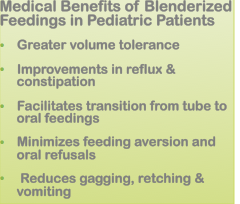
From ICAN: Infant, Child, & Adolescent Nutrition February 2009 vol. 1 no. 1 21-23
discussion of blenderized diets from medical professionals can be useful and give some ‘teeth’ to the blenderized diet anecdotes.
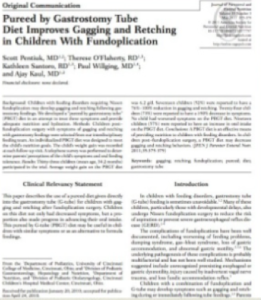
Pureed by gastrostomy tube diet improves gagging and retching in children with fundoplication (University of Cincinnati College of Medicine, 2011)
- Thirty-three children (mean age, 34.2 months) participated in the trial. Average weight gain on the PBGT diet was 6.2 g/d. Seventeen children (52%) were reported to have a 76%-100% reduction in gagging and retching. Twenty-four children (73%) were reported to have a ≥ 50% decrease in symptoms. No child had worsened symptoms on the PBGT diet. Nineteen children (57%) were reported to have an increase in oral intake on the PBGT diet.
- Conclusions: A PBGT diet is an effective means of providing nutrition to children with feeding disorders. In children post-fundoplication surgery, a PBGT diet may decrease gagging and retching behaviors.
In the past year, we’ve seen an increase in the number of published surveys and studies done, and they generally show the same results:
Blenderized Tube Feeding Use in Adult Home Enteral Nutrition Patients: A Cross-Sectional Study (Mayo Clinic, 2015)
“Most common reasons for using BTF were as follows: it is more natural (43%), like eating what their family does (33%), and tolerate BTF better (30%). In patients who use BTF, 80% reported maintaining goal body weight. BTF resulted in significantly less reported nausea, vomiting, bloating, diarrhea, and constipation compared with commercial EN. Conclusions: This is the first study to evaluate BTF use in an adult HEN population. More than 50% of our patients used and approximately 80% expressed a desire to use BTF if provided with adequate information.”
Tolerance of Pureed Diet by Gastrosonomy Tube in Pediatric Patients, Children’s Hospital of Michigan / Wayne State Medical School (Presented at NASPGHAN, 2014)
Conclusion: The pureed diet by GT is an alternative diet that is well received by families of patients. The pureed diet can improve the gagging / retching, oral tolerance, weight velocities, and stooling habits. Adverse effects of the pureed diet are limited.
The BLEND Study: A Feasibility study looking at children transitioning onto blenderized tube feeds, The Sick Kids (Presented at NASPGHAN, 2015)
Conclusion: Fewer subjects reported emesis and stools became firmer. Use of antacids, motility agents, and laxatives did NOT increase. 1.5 times more calories were required to maintain anthropometrics. Caregivers perception of BLEND was positive.
Short-Term Outcomes Using Blenderized Tube Feedings Among Gastrostomy-Tube Dependent Children, Children’s Hospital of Orange County (Presented at NASPGHAN, 2015)
Conclusion: Pediatric patients who are dependent on gtube feedings may benefit from BTF for improvement in stool consistency, vomiting, and gtube intolerance. Full BTF may result in better outcomes than combination foods. Frequent monitoring of anthropometric measurements is warranted to promote age appropriate growth.
—-
We’re happy to see the increased interest in studying blended diets (although I do like to tease that we’re studying putting real food into real stomachs – it’s been done for THOUSANDS of years!)
If you or someone you are caring for has a feeding tube and has any of the above-mentioned symptoms (vomiting, reflux, failure to gain weight, weight loss, diarrhea / constipation, oral aversion, feeding refusal, or general formula intolerance), these studies should help get your medical team on board with a blended diet. Our Real Food Blends meals can be a very simple way to implement a blenderized diet.
Questions? Comments? We’d love to hear from you below or on our Facebook page.
ALS Giveaway Results
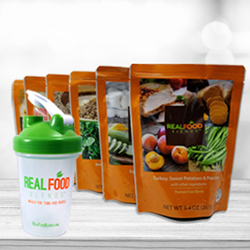
Last month, in honor of ALS Awareness Month, Real Food Blends gave away 600 meals to 100 PALS (that’s Patients with ALS.) We wanted to give them a chance to experience Real Food Blends and get their feedback on how the meals worked (or didn’t!) for them.
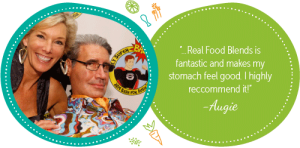
Augie Nieto of Augie’s Quest is a Real Food Blends fan!
For many years now, people who are 100% formula fed who add some real food into their tube-feeding program have been reporting positive changes, both to the way their body is functioning and how they feel about tube-feeding. Our meals are simply an easier way to access these benefits so we’re not really surprised by the results.
This was a very small, unscientific survey, but we asked each of our ‘taste’ testers to answer a couple of questions about their experience using Real Food Blends after one month. Most simply added in 1 Real Food Blends meal per day, replacing a can of formula for a few weeks:
- 60% reported a marked improvement in bowel habits
- 20% reported a noticeable improvement in volume tolerated (they could take more at one time, meaning they wouldn’t need to be fed as often.)
- Every respondent said they wanted to continue using Real Food Blends.
- 100% said that they “felt better about” having a Real Food Blends meal vs. a typical formula feed
- 100% said they would recommend Real Food Blends to others with ALS and a feeding tube.
We especially love those last two. There is such a psychological boon to giving someone a real meal….just like offering baked goods to visitors at your home! This is a concept that is rarely talked about in the medical field when discussing tube feeding but is very important, both for the person with a feeding tube and their loved ones. For those with ALS, we hope that having real food readily available provides not only much-needed nutrition, but also a bit of happiness.
Breakfast Blend update
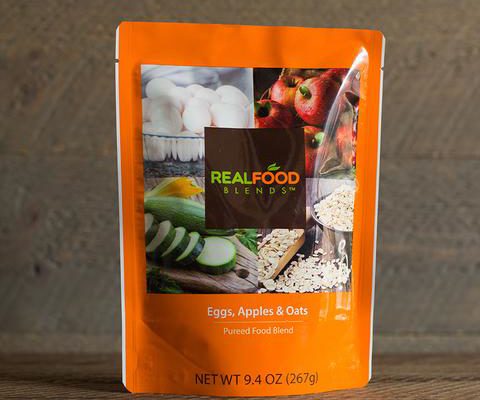
Anyone who’s been living with a feeding tube or tube-fed person long enough knows to always expect the unexpected. Have the back-up button readily available. Keep a stash of emergency food on hand. Always travel with extra syringes and tubing.
The same has been said about running a business. Expect the unexpected. But in this situation, even we didn’t expect this unexpected scenario. And ended up with(out) egg on our face.
 The samples we created and shipped earlier this year were wildly popular. Having a readily available “more normal breakfast food” option and in a powdered, customizable format went over very well with the majority of our ‘taste’-testers – and we know that most of our customers want even more meal options. Since then, we’ve been working to get everything in place for a large-scale production run of these new meals, but one thing we couldn’t control was the outbreak of Avian Flu.
The Avian Flu has caused a severe shortage of egg products on the commercial level (and most will start to see a big spike in the price of eggs at your local grocer soon, if you haven’t already.) This has created a global shortage that has unfortunately made one key ingredient in our breakfast blend impossible to provide for at least the next 6-12 months.
The show will go on.
Since we ran into this brick wall for the time being, we have pivoted

More shaking.
and plan to swap out the eggs in this blend with turkey (so the new powdered meal will consist of turkey, sweet potatoes, avocado and apples….should be a good one for the oral eaters too!) It’s a relatively simple swap but will delay our production slightly. Plan is to deliver these meals for sale no later than August 31st – hopefully sooner.
As soon as eggs are available at the commercial level, we do plan to launch a breakfast blend as well. Our apologies. We know many of you have been patiently waiting. Bird flu, who would have thought!!
Transitioning your 1-year-old tubie to a blenderized diet (BD)
The following is a guest blog post from Weronika Brill RN. More tips on transitioning to real food through the feeding tube are available here.
——–
For many “typical” parents, the transition to real food has already begun at or before the age of one and, it seems like an easy transition. But for parents of children that use a G-tube as a primary source for nutrition, it can seem like a daunting task.
When making a plan for transition I have a philosophy of trying to create as “normal” an atmosphere at home as possible. I believe in including your special needs child during mealtimes and having regular schedules for them. I also don’t believe in continuous night feeding unless medically necessary (which is very different from feeding a snack at night). And as a special needs mom myself, I know that the less your house becomes a hospital and more of a home, the happier everyone will be.
Before starting the transition to a BD I recommend you consider the following:
Set realistic goals
There are many BD Facebook groups where you see what I call, “super blending moms.” These moms add 40 different organic “super-foods” to their child’s meals and blend massive quantities of food, freezing a month worth of blends. Having a goal to do big batch blending, with a large variety of foods, may not be realistic initially; big batch blending might be a better goal for a toddler that has been tolerating BD for a while.
A realistic goal could be: “I’m going to find a few foods that my child tolerates very well and slowly add variety.” Another realistic goal may be: “my child is throwing up three times a day with formula meals; I am going to find one food a week that doesn’t make him/her throw up.”
Understand the work
Initially it may feel like meal preparation is going to consume all of your time, and it just might until you get the hang of it. Not only are you going to be trying out new foods for your child but also you are going to be adding an extra few steps that parents of “typical” children don’t have: blending, washing the blender and then feeding your child.
Don’t get overwhelmed
Many parents that I consult with fixate on too many issues and become overwhelmed quickly by the entire process. For example, I created a meal plan for a young couple whose child was throwing up a lot of her formula meals and having loose stools throughout the day. Because she wasn’t gaining weight and absorbing much on formula, the parents were consumed with her intake of calories and variety of nutrients. While these concerns are valid, they shouldn’t outweigh the main issue of excessive vomiting and loose stool.
In these situations parents need to step back and reevaluate goals–if they are to rid your child of
Weronika Brill is a registered nurse and consults with parents on real food tube feeding. Most importantly, she’s the mom to her tube-fed son!
vomiting and loose stool with formula feeds, then you must take the initial step of a slow transition. Once tolerance is established, calories, variety, and any further goals can be addressed.
Your blender is the key to success
You will need a professional grade blender, either a Vitamix or Blendtec, and usually any model will do. If you can’t afford a brand-new one, both companies offer refurbished models at almost half the price and with a warranty. (Editor’s note: Vitamix has put their medical discount program on hold.) If that is still too expensive, Ebay is a great option. If you can’t afford a blender or do not have the time to dedicate to meal preparation, you still have real food options such as Real Food Blends, which many insurance companies cover.
The transition
Transitioning can take time. I have seen some children take weeks to transition to a full blended diet while others can adapt quite quickly.
While many recommend transitioning to baby food and baby cereal, I like to take caution with these foods. This is because many special needs children that need to eat through a g-tube do so because of a neurologic deficit. I find that many of these children are sensitive to sugars, preservatives, processed, and high carb foods. Dr. Natasha Campbell-McBride, author of Gut and Psychology Syndrome, has noted a clear connection between digestive problems and neurological problems.
I don’t recommend any processed foods; all of my clients’ children start out with homemade bone broth. To get started, you can watch my “how to” video here or recipe here.
The schedule
Day 1. Start out with substituting one meal with clear bone broth and continue with all other meals the same.
Day 2. Make the first meal of the day bone broth and a little bit of chicken and carrot. If your child is tolerant of the broth mixture then continue replacing the rest of their meals with this mixture.
Day 3. If there are no egg allergies and it’s a typical food in the home, give a hard boiled egg yolk with half an avocado mixed with water for breakfast. Give the bone broth mix for the rest of the meals.
Day 4. Add a half of a fruit to your egg yolk and ½ avocado with a teaspoon of coconut oil. You can use the egg mixture once or twice a day with the bone broth mixture for the other meals.
As you ease into more variety you can add kale or spinach to your egg blend. You can later replace the ½ egg with a tablespoon of nut butter or ½ cup of unprocessed oatmeal or even ¼- ½ cup of Greek yogurt. You can use coconut milk (native forest brand has no additives) instead of water or whole milk.
You can also add more vegetables, like potatoes or green beans, to your soup blends.
If you decide to permanently leave dairy out then discuss a possible Calcium and Vitamin D supplement with your child’s pediatrician.
Real Food Blends
Once you’ve fully transitioned your child, you can introduce Real Food Blends. Many parents are interested in using Read Food Blends because they are pre-blended real food and, in many cases, covered by insurance. There are many people who use Real Food Blends exclusively for their nutritional needs (make sure to add a multi-vitamin!). Real Food Blends are also great for traveling or for school blends.
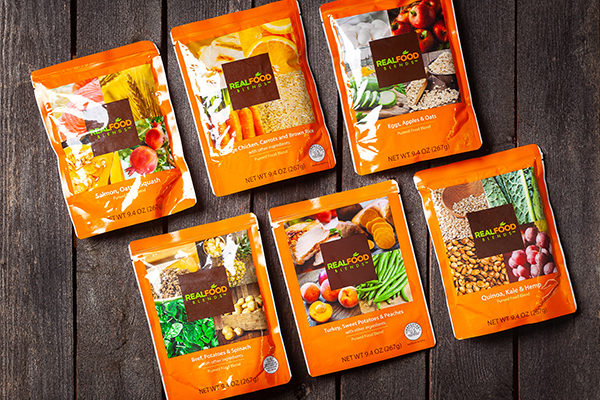
It’s important to consider that one package of Real Food Blends may contain enough protein for an entire day for a one year old with only about half the calories. For example, the Salmon, Oats & Squash blend has 12g of protein and 330 calories in 267g. I recommend adding a whole avocado (322 calories) and 160ml of Native Forest coconut milk (140 calories) to make a total of 792 calories. Add any additional water as needed and you have an entire days worth of food!
Considerations
Constipation
Low tone and high tone children are more likely to be constipated. Even “typical” children get constipated at times. You as a parent need to find a way to make your child have daily bowel movements. If you can’t find any foods that do it then you need to see their pediatrician to develop a bowel routine. It is critical that your child has a bowel movement on a regular basis to reduce reflux and improve overall comfort.
Probiotics
Your child needs to have probiotics included in their diet by either prescription or naturally from foods. Some are more potent than others, so I don’t recommend adding them to the mix. Yogurt is usually safe to mix but a probiotic like Bulgarian Buttermilk can spoil a whole blend quickly.
Water
Make sure your child receives enough water to have lots of wet diapers throughout the day. Since it is based on weight and maybe activity, your child’s pediatrician can give you the number for the exact amount of fluid your child needs for the day.
Keep it simple
Your child needs a variety of nutrients, which doesn’t always equate to a variety of food. A fruit such as an avocado contributes nearly 20 vitamins, minerals and phytonutrients, including vitamin E, vitamin C, folate, fiber, iron, potassium, 81 micrograms of lutein and 19 micrograms of beta-carotene. Something like a cookie can have a large variety of ingredients and calories but wouldn’t be considered nutritious. For this reason, I always try to tell parents to not be preoccupied with the variety of foods at first.
Keep your child’s pediatrician in the loop
Your child’s doctor should always be aware of any new diet. They might want to recommend a multivitamin or have you avoid certain foods that shouldn’t be consumed with a medication. They can also address any bowel issues that come up during the transition.
—-
Veronica Brill RN is available for private consultations. Please visit her Facebook page, Tweet her or email her at VeronicaBrillRN@gmail.com.
*The above content is not to be considered medical advice. Always consult your child’s medical team before any changes to their diet, especially children with feeding tubes.
ALS Awareness Month & Giveaway
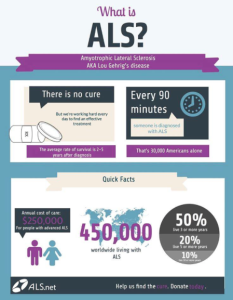 Today kicks off ALS Awareness Month. There are almost 500,000 people living with ALS right now, and most of them will require a feeding tube for nutrition at some point. We have been so honored that many our of customers with ALS have shared their stories with us, helping others afflicted with ALS know that real food is still possible after the feeding tube is placed.
We have heard stories from many people with ALS and their caregivers that the decision of when to get the feeding tube is a hard one. Oftentimes the tube is looked at as a visual, permanent reminder that ALS has taken another pleasurable thing away from the person: the ability to eat and enjoy real foods. Our hope is that in some way, our meals can help give a feeling of normalcy and make the transition to tube-feeding a little easier psychologically while delivering the benefits of real food nutrition.
To help spread awareness about ALS this month and give back to those in our community fighting this horrible disease, Real Food Blends donate 5% of all proceeds from sales of our Sample Pack or Variety Packs to the ALS Therapy Development Institute (with code ALS.)
600 Meal Giveaway
We are looking for ten people who have ALS and have used feeding tube nutrition for less than one year who would like to try our meals. In exchange for filling out two brief surveys, we will provide 5 cases (60 meals) of Real Food Blends to each person. Please email info@realfoodblends.com if you would like to participate.
If you would like to learn more about ALS & how you can help spread awareness, some of our favorite sites include Augie’s Quest, the ALS Therapy Development Institute, and The ALS Association. Please help spread the word about about ALS & that those with ALS can still enjoy real food by sharing on social media via the links below.