


Insurance Update
The insurance coverage picture for Real Food Blends is about as clear as mud these days! We are happy to report that more and more of you are having the meals covered by your insurance and provided directly from your DME (that’s a home health care company or Durable Medical Equipment company.) We wish this process was easier and we’re working to get coverage for as many tube-fed people as possible but these things take time. Here’s an update and answers to the most common questions about insurance coverage, and how you can secure coverage as well.
Why isn’t my DME willing to carry Real Food Blends?
First, they may just have not had anyone ask for it! This is a pretty simple problem to fix and usually the easiest way to have your insurer billed for the meals. Call your existing DME and tell them you would like them to verify your insurance coverage for HCPCS B4149. (Wholesale details are here.)
The second is a little more complicated but, like many things, boils down to money! Some state Medicaid programs don’t routinely cover formulas billed under this code. If the reimbursement rate isn’t published or if it’s really low, DMEs are unlikely to want to carry the meals as they need to be able to make some profit off providing the meals. If you are covered by another insurance or Medicaid is not your primary, it is still worth a call to your DME to ask for our meals / that they verify the insurance.
And finally, the last reason. Some of the larger DMEs have been unwilling to carry the meals despite customer demand for a variety of reasons (mostly, change is hard!) This tide is slowly changing, and the more vocal you all are about leaving a DME for one that will provide these meals, the more you are paving the way for those that come after you. One way you can help is to ask your RD to tell the sales reps from the big DMEs that they want the meals!
What can I do?
1 – Find a Local DME: Ask your medical team / dietitian for referrals to local DMEs. The smaller, local businesses have proven much more willing to go above and beyond for a customer, especially a new customer that has recurring medical needs. (If you are willing to switch your entire DME needs over to them, they are usually even more wiling to provide our meals as they make a much higher profit off the medical supplies than formulas typically. Make sure you tell your existing DME why you are leaving! (The list of current DMEs stocking our meals is here.)
2 – File for reimbursement. You can purchase the meals directly from us and use these steps to file for reimbursement from your insurer.
3 – Lobby your insurer. If you get a denial for our meals, either from your DME or for reimbursement, we can assist with the appeal process. Sometimes, under some plans, insurers will routinely deny any specialized formula on the first submission. During the appeal process, a real live human usually reads the reasoning for the special request and can use common sense to determine if the request should be approved.
4 – If your insurance is listed here, you can call Medline at 1-866-356-4997. They will verify your insurance coverage and ship out the meals directly to you.
What else to know?
Read through our insurance page to get more of an understanding about how insurance coverage / the reimbursement process works. And then get creative! We have some families using crowd funding to help pay for the meals (don’t be embarrassed, you’d be surprised how many people love having a tangible way to help!) Also, our monthly subscription program saves you 10% off the cost of the meals. Hope that helps clear up some confusion. Please reach out if you have any questions. We are here to help!
Blenderized Diet by Gravity
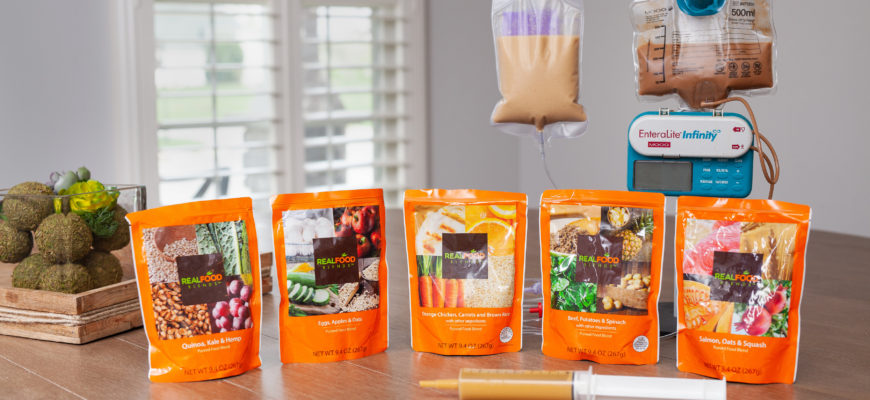
One of the most common questions we get from first time customers – or those that want to try our meals – is if the meals can go through a gravity bag or feeding pump. The answer is yes, with some adjustments.

Salmon meal being gravity fed with 1 oz water.
Real Food Blends meals are intentionally thicker than traditional formulas. Not only does the thickness allow us to increase the calories per ounce, but also tends to help with a feeling of satisfaction, and improve reflux symptoms. Whenever possible, we recommend bolus feeding the meals with a syringe. Many people who can’t tolerate a bolus of formula can tolerate a bolus of real food. (We even have nurses in hospitals bolus feeding the meals now – one told me “I’d rather bolus a patient every few minutes than clean the inevitable diarrhea from the formula!”)
However, just like some people like their eggs over easy and some scrambled, these are your meals to feed how you see fit! If you want or need to use a gravity bag or pump, you’ll need to add extra fluid to make them flow well. Our recommendations follow:
Salmon : Add 1-2 oz. of fluid of choice.
Quinoa – Add 2 ounces of fluid of choice.
Chicken – Add 2 ounces of fluid of choice.
The fluid you add could be water, milk or milk alternatives, vegetable or fruit juice, or bone broths. Your meal, your choice, but make sure you are accounting for those calories if necessary.
If the bag stops dripping you may need to shake it around a bit to mix up the food as the heavier particles drop to the bottom of the bags, thanks to gravity.
Here is the chicken meal with 3 ounces water being gravity fed. You can see we still tried to maintain some thickness:
And the quinoa meal with 2 ounces of water added:
Enjoy!!
*The manufacturers of feeding pumps have specifically stated that their pumps are NOT to be used with anything but commercial formula so use a pump with real food at your own risk. This is not intended to be medical advice. Always check with your medical team before making any changes to an enteral nutrition program.
Cleaning Feed Tube Extension Sets
“Necessity is the mother of invention”. Truer words have never been spoken when it comes to living with a feeding tube. From the beloved squirrel syringes to modifying feeding pump bags, the feeding tube community often has the best tips and tricks to make the process easier. The one thing we can’t seem to agree on is the hands-down best way to clean the feeding tube extension sets!
A tried & true method of cleaning a feeding tube extension.
We’ve reached out to the tubie community to find the best way to clean the feeding tube extension sets. Although there’s no one winner, some of the responses were downright ingenious. Instead of trying to summarize, here’s some of our favorite responses:
“I clean the bolus port part very gently with a flexible dental pick if needed.” –Lisa G.
Tanya H. got creative by sharing this, “I do the same beginning process that I do with my milking machine lines for milking goats…… first run very cold water thru tube lines first. Hot water will cook the milk/formula/feed onto the tube. Then I run hot soapy water thru. Then every day I soak in a solution of vinegar & water to disinfect. Use new extension every week.”
Jodi M. shares that “White vinegar works great followed by hot water flush.”
A more detailed way of cleaning with hot water and dish soap comes from Heather G. She says to “Soak in hot water, dish soap (Palmolive) and 2-4 denture tables (efferdent) for 30min. Rinse with hot water and air dry.”
Brittany H shares that “I roll the tube between my fingers to get the crud out…. and use a bottle brush (the end made for the bottle nipple) to clean out the top of the extension.”
”I was told don’t use anything you wouldn’t eat…and hot water with a mixture of 1/4 cup to 1tbsp baking soda. Works like a charm.” –Les R.
Eugena M. shares “I use dawn soup with a cap full of bleach soak a few hours and air dry.”
”I use an endoscopy brush and hot, soapy dishwater. It has a small end that fits regular extensions, a large end that fits bolus extensions. They are 6′ long so you can clean the 4′ Kangaroo tubing extensions as well. You can also use the large end (of a separate, designated one) to clean suction tubing.” –Liz A.
Patty M. says that “Once every couple weeks I run really hot water through them with a drop of antibacterial soap. Just have to make sure you run a lot of hot hot water through to get all the soap out. After each feed I always rinse out with just plain hit water.”
”We were taught to fill with coco cola and clamp off and let ‘soak’ for 12 hours then rinse while we were in the NICU after our little one got his tube. It works for cleaning and staying flexible!!” –Charissa R.
”Pepsi! And don’t put them in hot water. Any extreme temperatures seems to harden them. But, if they’re used frequently, start a new one weekly.” –Michelle C.
Cleanliness and hygiene is important so make sure however you are cleaning your feeding tube extension sets, your medical team is on board.
Did we miss a good feeding tube extension cleaning solution? Please comment here or on our Facebook page so we can share with others!
Ten Things To Know About Real Food Blends Meals

1- Each meal is 100% real food, pureed to fit through a feeding tube. There’s nothing synthetic or artificial added.
2- These meals are NOT formula. They are meals, meant to be enjoyed in conjunction with each other, a homemade blended diet or even formula. Meal plans are available here.
3- No prescription needed!! Our meals are not drugs so you don’t need a written prescription to buy. You can order here or contact your Durable Medical Equipment company to have billed to your insurance.

Start with a sample pack. Order now!
4- Nutritional variety is key to health! We wouldn’t recommend anyone live off the same thing, every day, for every meal, which is why we have 6 different meals to be used in conjunction with each other. Check out this transition guide for help getting started with RFB. (
5- No refrigeration required!
6- These meals are produced in an FDA & USDA regulated facility, and made shelf-stable by a high-heat process, the same process that canned baby food goes through to be made shelf-stable.
7- Each Real Food Blends meal was tested on a 14fr G-tube. They’re not recommended for NG/ NJ tubes as the tube size is so small. Although we have not tested, some of our RFB customers do use our meals through J-tubes or 12fr G-Tube (additional liquid is needed to pump feed through these smaller tubes. Details here. Always discuss with your medical team.)
8- Who can have these meals? Typically, anyone with a G-tube that doesn’t have (or didn’t have prior to the tube being placed) major digestives issues. If the digestive system is intact and working, they should be able to benefit from a real food diet. (Remember, reflux / GERD, constipation and other ‘digestive’ systems have been known to improve on real food versus formula! Also remember that formula intolerance can ‘mask’ the fact that the digestive system was working prior to being fed a formula-only diet.)
9- Insurance covers these meals for many people. Plans and policies can vary so check with your DME or insurance company (HCPCS code B4149) for coverage criteria but it’s often as simple as getting the orders from your doctor and submitting to your DME.
10- The meals are intended to be bolus fed with a syringe but can fit through most feeding pumps. (Most people that switch to a real food by tube diet find that the body is able to handle more food in less time – think about how the oral eaters of the world eat a ‘bolus’ meal in a relatively short period of time. Just because a tube-fed person can’t tolerate a bolus of formula doesn’t mean they won’t tolerate a bolus of real food. Start slowly and work with your medical team.) This video shows the various ways to feed and tips & tricks on bolus and pump feeding.
If you want to get started, you can pick up a sample pack of our 3 meals to test out at home. Always consult with your medical team before making any changes to a tube-fed person’s diet.
Blend On!

As the founder & CEO of Real Food Blends, many people are surprised to learn that I still make blends for my son AJ. I’ve been blending for him for three years now, it’s almost second nature! I find making his food to be healing in many ways – he gets a lot of what the rest of the family eats as he should since he’s part of the family!
All of us at Real Food Blends believe that fresh food is best and encourage anyone with a feeding tube or caring for someone with a feeding tube to discuss a homemade blenderized diet with their medical team. But we also know that the time, effort and work involved in making a blended diet is .. a lot. Even now, after 3 years and being in a good routine with AJ’s blends, it’s still work. I’m thankful to have Real Food Blends to rely on when I don’t feel like cooking that day, and that I no longer have to stress when the freezer stash is getting low, knowing that I need to do another marathon shopping, prepping, cooking & blending session. Like this:
That was a few days worth of meals and relatively easy blends. Plus, it helps to have two sinks and two Vitamix containers!
As summer starts and our meals are once again readily available, we hope that our blending families can relax a bit, maybe enjoy vacation a little more without coolers of dry ice & carrying their blender around! With our meals in your pantry you or your loved one can still have a 100% real food meal, and a little time out of the kitchen.
Blend on!