


Our Family’s Feeding Tube Story

This is the second post in a series during Feeding Tube Awareness Week. Our first post on Famous Tubies is here. Feeding Tube Awareness Week 2015 is focused on The Truth of Tube Feeding. This is my family’s truth / story of how we became a tubie-family and the trials & tribulations almost 4 years later.
My son AJ was born a little early due to being small for gestational age in utero and he came out healthy, yet small, at 37 weeks. We took him home from the hospital in two days and spent the next 5 months nursing, bottle feeding and trying to get him to sleep! None of which went really well but he did manage to stay on his little 3rd percentile curve with no major illnesses.
All that changed when he had a major seizure just before turning 6 months. That seizure landed us in a children’s hospital for a week to determine just what was going on. One of the specialists who saw AJ was a feeding therapist who instructed us to thicken his bottle feeds to help him eat more / swallow better. Little did we know that due to this hypotonia, this was not good advice. He tired out very easily trying to get the thicker formula from the bottle, and 4 weeks later we were back for a swallow study just to rule things out.
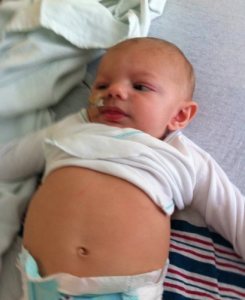
First day of NG feedings…he took that tube out twice that night! Also last picture of his tummy without a stoma.
We went into that appointment completely unprepared, not knowing we has just fed our son the last bottle he would ever take orally. AJ managed to fail the swallow study with flying colors – aspiration on all liquid, completely NPO and go straight to the hospital for an NG tube. There we were told he was going to need the tube for at least 6 months so a G-Tube was in his future, but we were more than welcome to take him home with the NG as long as we could learn to reinsert. Considering that he pulled it out twice in the first night were we there, my husband and I decided we weren’t leaving without the button.
Life with a Feeding Tube
The following days were a blur of surgery, learning how to use the MIC-KEY, how much formula to push and how to use the pump. We went home and did everything we could to follow doctor’s orders. Went to more specialists, tried continuous feeds, slowing the rate down, night feeds (OMG I break out in a cold sweat thinking about rushing into his room in the middle of the night to a find my child choking on his own vomit. We quickly dropped the night feeds!), anything that would help us get the prescribed amount of formula into him. Nothing worked.
Eventually, thanks to the kindness of others that have been through this, we found out about blended diets and things got easier. No more daily vomiting, no more constant constipation. I felt more like AJ’s mom again and less like his nurse. He ate what we ate. Our family settled into a new normal. I started to look at the tube as a blessing as I was able to give his seizure meds, fantastic nutrition and keep him hydrated during illnesses without issue.
Accepting the Feeding Tube
We hope that one day AJ will be an oral eater and we’ve tried to make that happen, but like most things with AJ, it’ll happen on his time. For now, I’ll keep providing him with a plethora of nutritious foods to support his development.
It took me a long time to get to this place. I was angry for a long time – angry that my kid needed a feeding tube and that I had to stop nursing so abruptly. Mad that my kid was puking everyday. Mad that no one in the medical community told us about blended diets. Creating Real Food Blends has helped channel that anger into a positive. Being able to help other kids, adults & families to have easier access to real food & all it’s amazing benefits has been healing. Thank you to all of you that have shared your pictures & stories with us.

AJ at almost 4 years old.
In hindsight, my biggest regret is not that we got the G-Tube but actually rushing into it. I know many families struggling with the decision to tube or not for quite some time but for us it was super-fast and unexpected – literally he was having the surgery 72 hours after failing that swallow study. That one failed swallow study landed AJ an NPO order and scared the crap out of us.
We learned over the coming months that a swallow study isn’t the be-all, end-all of the “tube-or-not” decision. It’s a point in time in an artificial & scary environment. AJ had never fallen off his growth curve or had a lung infection – two signs of real aspiration. But who knows? He may have ended up on the tube anyway and perhaps the tube saved him from some scary, life-threatening lung infections. We’ll never know and that’s okay. Having a feeding tube is not the end of the world and doesn’t define who he is. He’s quite enjoying his role as our Chief Inspiration Officer!
I’d love to hear your tube-feeding story. Feel free to comment here or on our Facebook page.
Famous People & Feeding Tubes
This is the first post in a series we will be doing in honor of
Feeding Tube Awareness Week.
One of the hardest parts of having a feeding tube or caring for someone that does, can be that lonely feeling of “I’m the only person I know with a feeding tube” or “I don’t know anyone else who has to feed their child this way.”
In honor of Feeding Tube Awareness Week, we’d like to introduce you to some famous people that have had / have a feeding tube to show you that you are not alone!
Roger Ebert
Perhaps the most famous tube-feeder of all time, Mr. Ebert lived for over seven years after cancer took his ability to eat orally. He penned this piece about his tube in 2011 and by talking publicly about his feeding tube, he took away some of the stigma.
I had the pleasure of meeting Mr. Ebert & his amazing wife Chaz numerous times to discuss Real Food Blends, and he was excited about the idea of giving real food to people on tubes. He truly LIVED with a feeding tube and we’re thankful he spoke out publicly about it.
ALS Warriors
The names Pete Frates and Augie Nieto might not be instantly recognizable, but you know their work!
If you found yourself dumping a bucket of cold water over your head last year in the name of ALS research, you can thank Pete Frates! Pete is the founder of the ALS Ice Bucket Challenge – need we say more? This challenge raised a ton of awareness for ALS and over $100 million for ALS research. If you are a mom caring for a tube-fed child, check out this TED Talk from Pete’s mom, Nancy. Amazing people!
If you belong to a gym, chances are you can thank Augie Nieto for that favorite piece of exercise equipment. He founded Life Fitness, and after his ALS diagnosis, went on to found Augie’s Quest which has raised more than $44 million for ALS research. You may have seen him on the Today Show too!
Jim Kelly
Former Buffalo Bills quarterback & NFL Hall of Famer Jim Kelly relied on a feeding tube in 2014 as he battled sinus cancer. Thankfully he is now tube-free. He and his wife Jill were also parents to a tube-fed son and founded Hunter’s Hope to spread awareness about Krabbe’s Disease.
____
The next time someone asks about the tube, you can list off these names and say “See, you actually do ‘know’ others on a feeding tube. It’s not so weird!”
Please visit & support Feeding Tube Awareness Week. This week, Real Food Blends will be donating 5% of all online sales to support this fantastic organization.
FEEDING TUBE AWARENESS WEEK® is a registered trademark of Feeding Tube Awareness Foundation, Inc. and is used here under license. Use of the name Feeding Tube Awareness and the Feeding Tube Awareness logo does not imply endorsement.
Thanksgiving Dinner Blend Recipe For Tube-Feeding
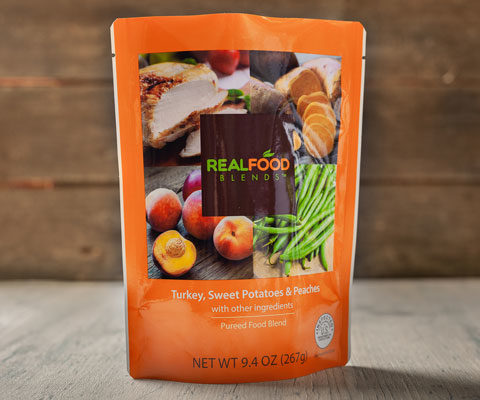
Thanksgiving – and the holidays for that matter – can be especially hard on tube-fed people and their families as everyone else is focused on FOOD! We firmly believe that if you are tube-fed and able to digest real food, there’s no need for them to miss out on Thanksgiving dinner. We’ve put together this quick & easy Thanksgiving dinner blend recipe to so your tube-fed loved one can participate in the meal too. Pull up a seat to that table & open up the tube!
For this recipe, we used one cup each of
- Turkey (take the skin off if you don’t have a very powerful blender)
- Mashed Potatoes
- Stuffing
- Cranberries
- Green Beans
And two cups of whole milk. (You can use any liquid you want, we used milk for the calories & since most people have on hand.)
- Put turkey and some milk into the blender and let ‘er rip.
- Add the rest of the ingredients in order, and the rest of the milk. Puree until smooth. The blend should be plenty pourable and easy to bolus feed.
Don’t forget to save the turkey bones for bone broth for blending!
Couple of notes:
- Notice we didn’t use a Vitamix or Blendtec. We wanted to make sure that a typical kitchen blender could blend well enough to fit through a regular feeding tube. (We tested on a 14 fr with no problem but recommend straining to make 100% sure you don’t clog the tube.)
- This is not medical advice or a recommendation. If you or your tubie have never had real food, Thanksgiving might not be the best day to try it.
- Use safe kitchen handling practices. Don’t use any food that’s been setting out for too long or leave the food out for too long after blending. If you wouldn’t eat it, don’t blend it.
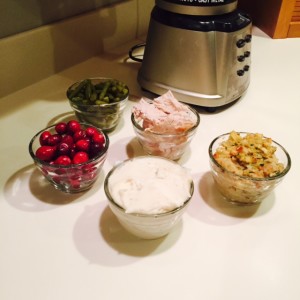
One cup of each. Easy peasy.
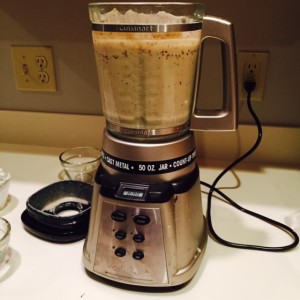
Mmmm, turkey.
Finally, although we firmly believe counting calories on Thanksgiving is un-American, here is the basic nutrition information & recipe we used. If you need more fat, throw in some gravy or butter or olive oil – or use the green bean casserole vs. plain green beans. More protein? Throw in more turkey. The recipe yields 40 ounces – about 5 – 8 ounce servings – enjoy the leftovers too! 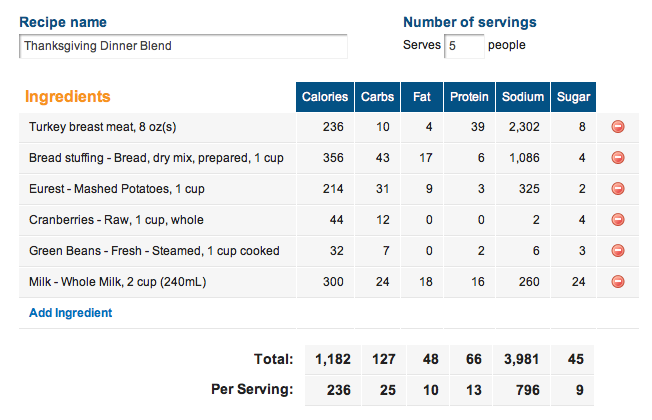 (Yes, we realize encouraging fresh blending might mean we sell a few less of our meals but we believe there are times that the psychological benefit to sharing a meal with family and friends far outweighs the importance of our bottom line. We hope all our tubies can enjoy Thanksgiving meal with their families!) Finally – pick up a shirt to show your support for #turkeyfortubies:
Enjoy! You’ve earned a tee shirt:
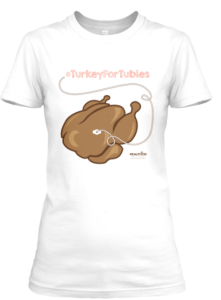
You really can buy this if you want: http://teespring.com/turkeyfortubies
Insurance Update
The insurance coverage picture for Real Food Blends is about as clear as mud these days! We are happy to report that more and more of you are having the meals covered by your insurance and provided directly from your DME (that’s a home health care company or Durable Medical Equipment company.) We wish this process was easier and we’re working to get coverage for as many tube-fed people as possible but these things take time. Here’s an update and answers to the most common questions about insurance coverage, and how you can secure coverage as well.
Why isn’t my DME willing to carry Real Food Blends?
First, they may just have not had anyone ask for it! This is a pretty simple problem to fix and usually the easiest way to have your insurer billed for the meals. Call your existing DME and tell them you would like them to verify your insurance coverage for HCPCS B4149. (Wholesale details are here.)
The second is a little more complicated but, like many things, boils down to money! Some state Medicaid programs don’t routinely cover formulas billed under this code. If the reimbursement rate isn’t published or if it’s really low, DMEs are unlikely to want to carry the meals as they need to be able to make some profit off providing the meals. If you are covered by another insurance or Medicaid is not your primary, it is still worth a call to your DME to ask for our meals / that they verify the insurance.
And finally, the last reason. Some of the larger DMEs have been unwilling to carry the meals despite customer demand for a variety of reasons (mostly, change is hard!) This tide is slowly changing, and the more vocal you all are about leaving a DME for one that will provide these meals, the more you are paving the way for those that come after you. One way you can help is to ask your RD to tell the sales reps from the big DMEs that they want the meals!
What can I do?
1 – Find a Local DME: Ask your medical team / dietitian for referrals to local DMEs. The smaller, local businesses have proven much more willing to go above and beyond for a customer, especially a new customer that has recurring medical needs. (If you are willing to switch your entire DME needs over to them, they are usually even more wiling to provide our meals as they make a much higher profit off the medical supplies than formulas typically. Make sure you tell your existing DME why you are leaving! (The list of current DMEs stocking our meals is here.)
2 – File for reimbursement. You can purchase the meals directly from us and use these steps to file for reimbursement from your insurer.
3 – Lobby your insurer. If you get a denial for our meals, either from your DME or for reimbursement, we can assist with the appeal process. Sometimes, under some plans, insurers will routinely deny any specialized formula on the first submission. During the appeal process, a real live human usually reads the reasoning for the special request and can use common sense to determine if the request should be approved.
4 – If your insurance is listed here, you can call Medline at 1-866-356-4997. They will verify your insurance coverage and ship out the meals directly to you.
What else to know?
Read through our insurance page to get more of an understanding about how insurance coverage / the reimbursement process works. And then get creative! We have some families using crowd funding to help pay for the meals (don’t be embarrassed, you’d be surprised how many people love having a tangible way to help!) Also, our monthly subscription program saves you 10% off the cost of the meals. Hope that helps clear up some confusion. Please reach out if you have any questions. We are here to help!
Cleaning Feed Tube Extension Sets
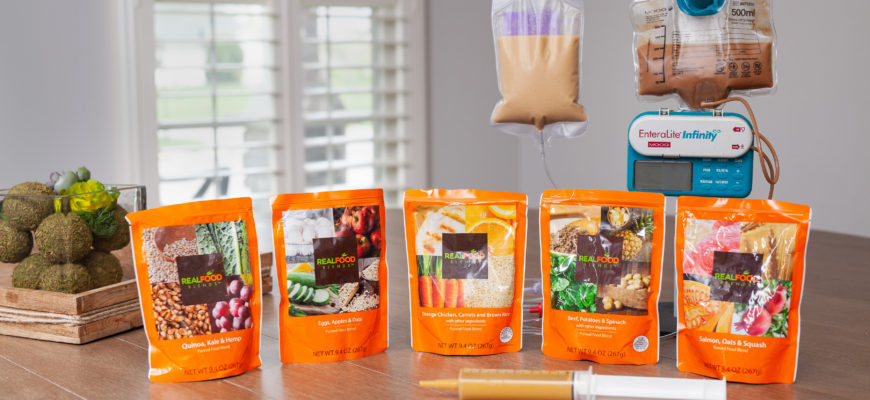
“Necessity is the mother of invention”. Truer words have never been spoken when it comes to living with a feeding tube. From the beloved squirrel syringes to modifying feeding pump bags, the feeding tube community often has the best tips and tricks to make the process easier. The one thing we can’t seem to agree on is the hands-down best way to clean the feeding tube extension sets!
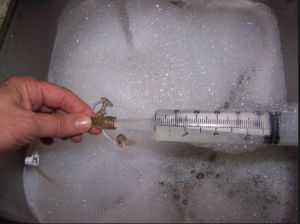
A tried & true method of cleaning a feeding tube extension.
We’ve reached out to the tubie community to find the best way to clean the feeding tube extension sets. Although there’s no one winner, some of the responses were downright ingenious. Instead of trying to summarize, here’s some of our favorite responses:
“I clean the bolus port part very gently with a flexible dental pick if needed.” –Lisa G.
Tanya H. got creative by sharing this, “I do the same beginning process that I do with my milking machine lines for milking goats…… first run very cold water thru tube lines first. Hot water will cook the milk/formula/feed onto the tube. Then I run hot soapy water thru. Then every day I soak in a solution of vinegar & water to disinfect. Use new extension every week.”
Jodi M. shares that “White vinegar works great followed by hot water flush.”
A more detailed way of cleaning with hot water and dish soap comes from Heather G. She says to “Soak in hot water, dish soap (Palmolive) and 2-4 denture tables (efferdent) for 30min. Rinse with hot water and air dry.”
Brittany H shares that “I roll the tube between my fingers to get the crud out…. and use a bottle brush (the end made for the bottle nipple) to clean out the top of the extension.”
”I was told don’t use anything you wouldn’t eat…and hot water with a mixture of 1/4 cup to 1tbsp baking soda. Works like a charm.” –Les R.
Eugena M. shares “I use dawn soup with a cap full of bleach soak a few hours and air dry.”
”I use an endoscopy brush and hot, soapy dishwater. It has a small end that fits regular extensions, a large end that fits bolus extensions. They are 6′ long so you can clean the 4′ Kangaroo tubing extensions as well. You can also use the large end (of a separate, designated one) to clean suction tubing.” –Liz A.
Patty M. says that “Once every couple weeks I run really hot water through them with a drop of antibacterial soap. Just have to make sure you run a lot of hot hot water through to get all the soap out. After each feed I always rinse out with just plain hit water.”
”We were taught to fill with coco cola and clamp off and let ‘soak’ for 12 hours then rinse while we were in the NICU after our little one got his tube. It works for cleaning and staying flexible!!” –Charissa R.
”Pepsi! And don’t put them in hot water. Any extreme temperatures seems to harden them. But, if they’re used frequently, start a new one weekly.” –Michelle C.
Cleanliness and hygiene is important so make sure however you are cleaning your feeding tube extension sets, your medical team is on board.
Did we miss a good feeding tube extension cleaning solution? Please comment here or on our Facebook page so we can share with others!